
Minutes for Your Money: The UK Entertainment Value Index
Everyone experiences culture and entertainment differently. One person might feel truly touched when standing in front of a painting in a gallery. For one person, a night comes alive in a stadium with a last-minute goal. For another, it could be a night in the West End, either a play or a big musical that hits the spot. Those are live moments you just can’t recreate at home.
That’s what makes entertainment so valuable, and also what makes it so hard to measure. The emotional impact of a night out can’t be standardised. It depends on personal taste, mood, who you’re with, getting there and back, and even the view from your seat. So any attempt to rank activities by “quality” is always going to miss the point.
Sure, experiences are subjective, but almost every ticketed night out has one thing in common: it buys you time. And time is something you can compare.
That’s why London Theatre Direct created the UK Entertainment Value Index, to see how 12 popular ticketed nights out stack up when you look at them through the same lens.
Cost per minute = average
ticket price ÷ typical duration
It’s not a verdict on what’s “best”. Think of it as a planning tool, a way to check the value of your nights out and decide what type of experience you want for your money.
Bottom line: the data shows entertainment minutes in the UK can be cheap… or wildly expensive.
What this report covers
In the sections below, you’ll find:
- The league table: where different activities land on pence per minute.
- The “two-speed” ticket economy (and the step change between casual plans and big-occasion spending).
- Where theatre and musicals land once you compare time for time.
- The comparisons people rarely make, until duration flips the story.
Key findings at a glance
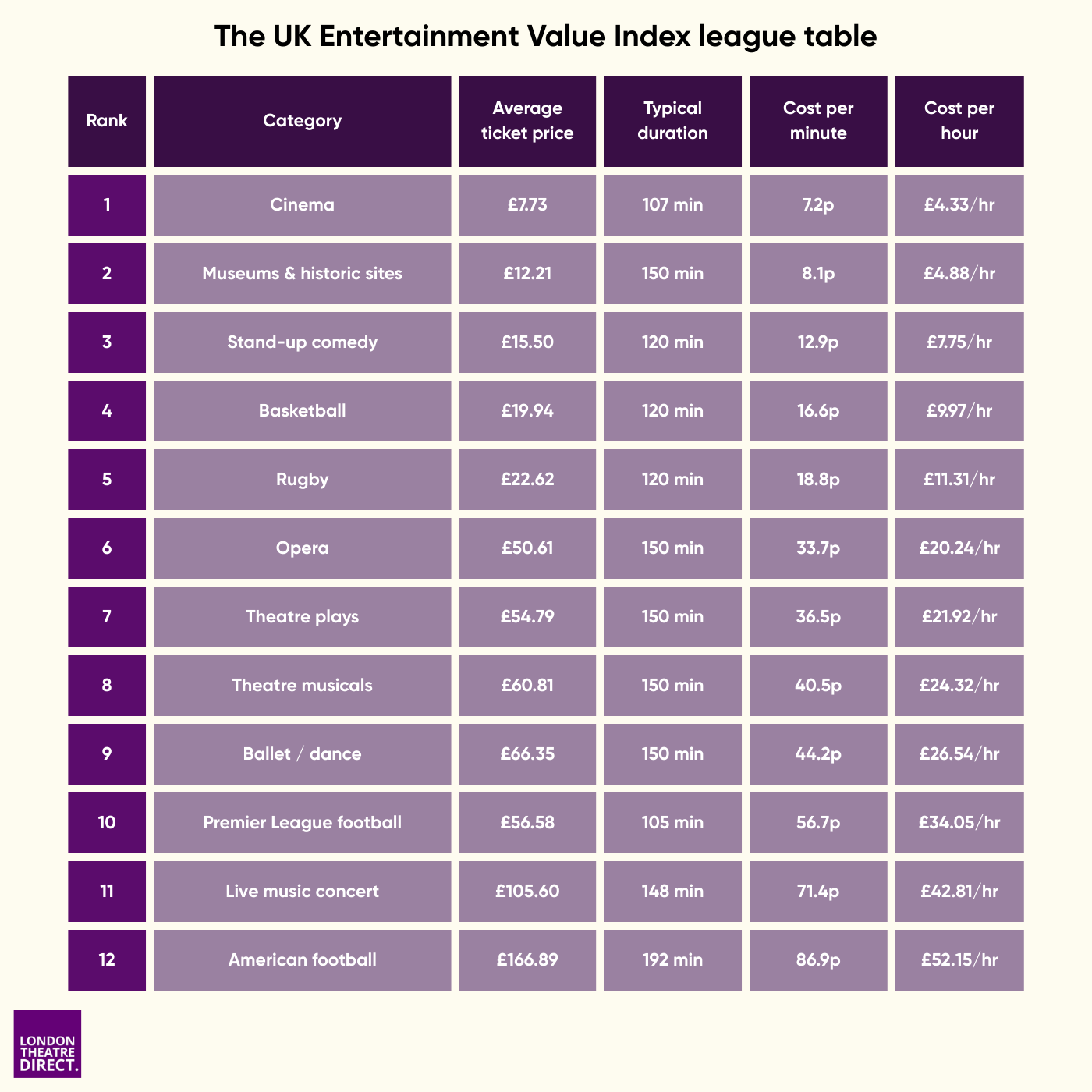
Cinema is the cheapest activity in the index at 7.2p per minute, based on an average ticket price of £7.73 and a typical runtime of 107 minutes.
Ticketed museum exhibitions and paid-entry historic sites come a close second at 8.1p per minute (average £12.21, typical visit 150 minutes). This figure is intended to reflect paid experiences rather than free general admission collections.
The more interesting pattern isn’t just which nights out are cheapest, it’s the jump in cost once you move from everyday plans into major, ticketed events.
The premium bracket starts at opera, which comes in at 33.7p per minute.
And in that “big night out” territory, theatre holds up well. Not by being the cheapest overall, but by staying competitive on cost-per-minute against other premium experiences:
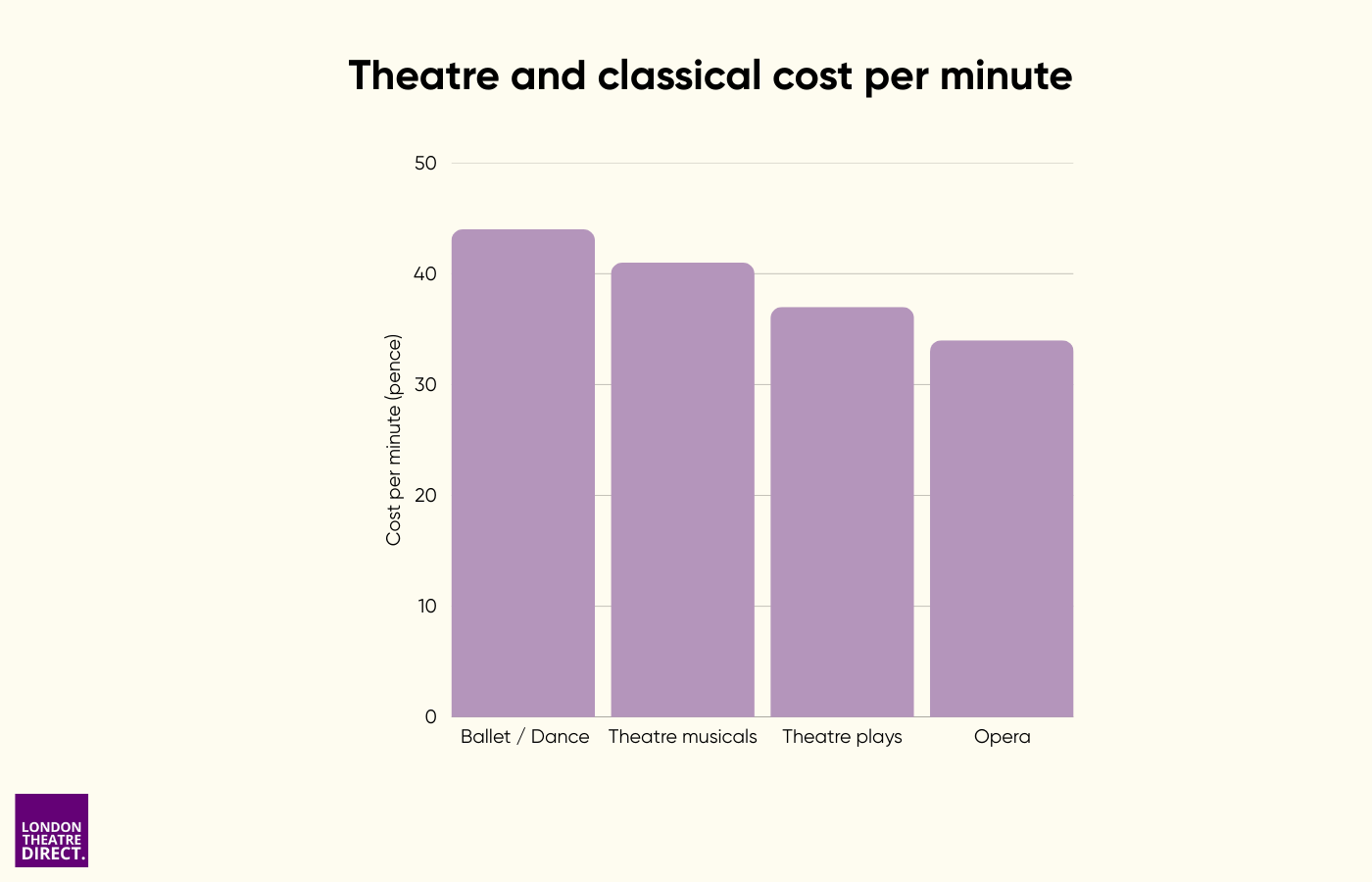
- Opera: 33.7p/min
- Theatre plays: 36.5p/min
- Theatre musicals: 40.5p/min
- Ballet/dance: 44.2p/min
For a familiar benchmark, Premier League football comes in at 56.7p per minute in this index (based on an average ticket price of £59.58 and a typical match length of 105 minutes, including half-time).
At the top end, American football is the most expensive category at 86.9p/min, around 12× the cost per minute of a cinema trip
Ticket price alone can mislead - when you include duration, “value” can reverse.
The bigger story: the UK has a “two-speed” ticket economy
When you compare by time-for-money, UK ticketed leisure starts to look like two different markets living side-by-side.
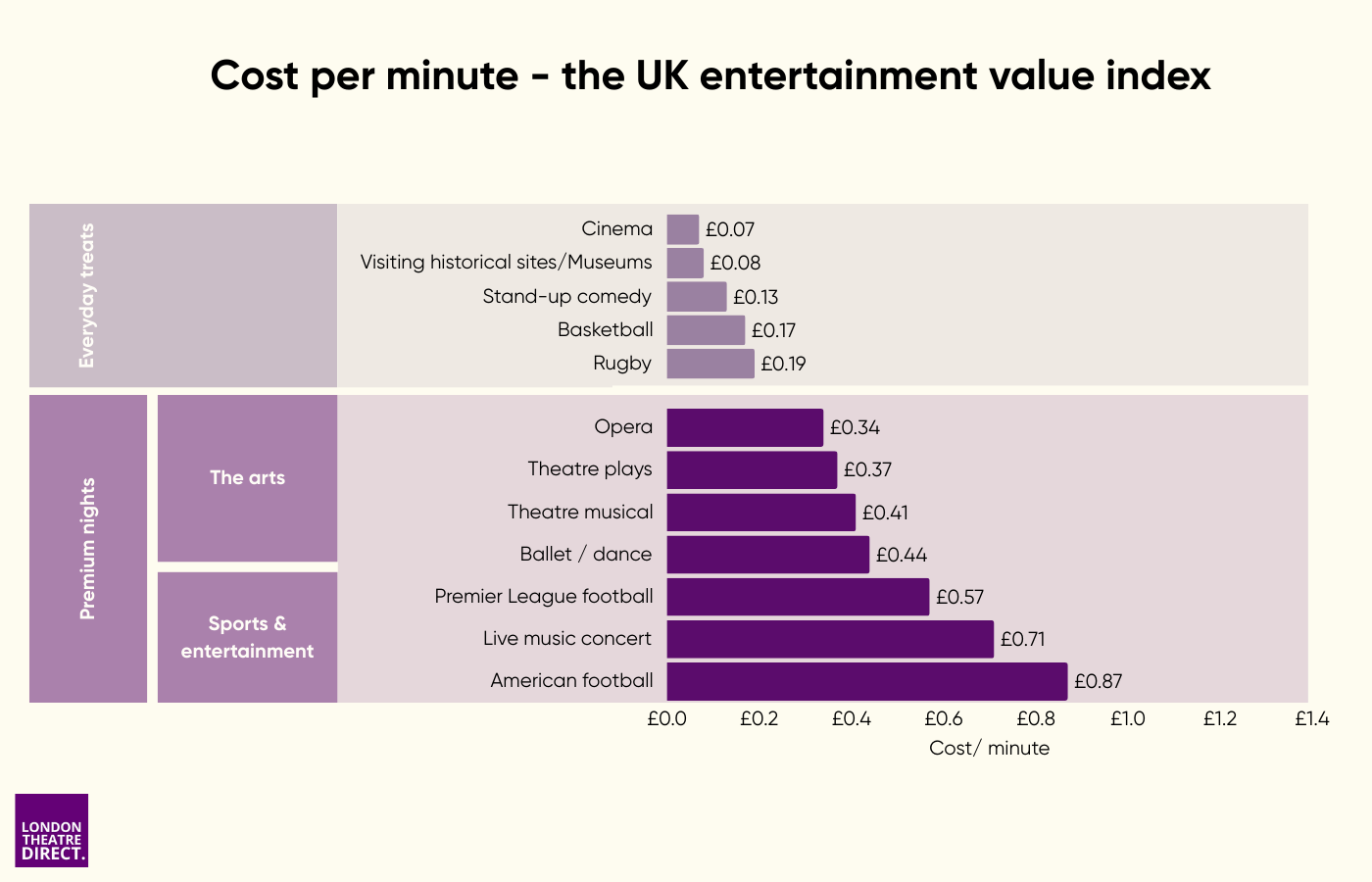
On one side are the everyday treats: affordable minutes you can fit into your regular plans. On the other is a sharp step up into big-occasion experiences, where the numbers cluster from roughly 33.7p per minute up to 86.9p per minute.
In other words, a casual plan and a “proper night out” aren’t just different vibes. They’re different economic planets.
The clearest step change in the dataset happens after ~20p per minute, jumping straight into the 30–40p per minute premium bracket.
Where theatre shines: premium experiences that hold up on time-for-money (especially once you include duration)
The best way to read this index isn’t “what’s cheapest?” It’s “what holds up once you compare premium experiences on a level playing field?”
That’s where theatre stands out. Theatre categories are generally seen as more premium experiences, but when you measure cost-per-minute, they sit below several other big-ticket activities.
A simple way to see it: in this index, all four theatre categories cost less per minute than Premier League football (56.7p/min), live music concerts (71.4p/min), and American football (86.9p/min). That doesn’t make theatre “better”. It just means that once you compare time for time, it’s more competitive than the headline prices might suggest.
Within theatre:
- Opera is the lowest cost-per-minute theatre category at 33.7p/min
- Theatre plays follow at 36.5p/min
- Theatre musicals come in at 40.5p/min
- Ballet/dance sits at 44.2p/min
Musicals are a great example of how this index changes the conversation, especially with blockbuster shows like Matilda, Hamilton or Wicked. Big titles can feel expensive upfront, but many deliver a full-length evening. And when you compare like-for-like across premium categories, that runtime matters.
Theatre tickets can look pricey upfront — but on cost-per-minute, plays and musicals sit in line with many premium live events once duration is included.
When duration flips the story: the comparisons people don’t usually make
Theatre musicals vs Premier League football (the value reversal)
On average, a Premier League ticket in this dataset (£59.58) is £1.23 cheaper than a theatre musical ticket (£60.81).
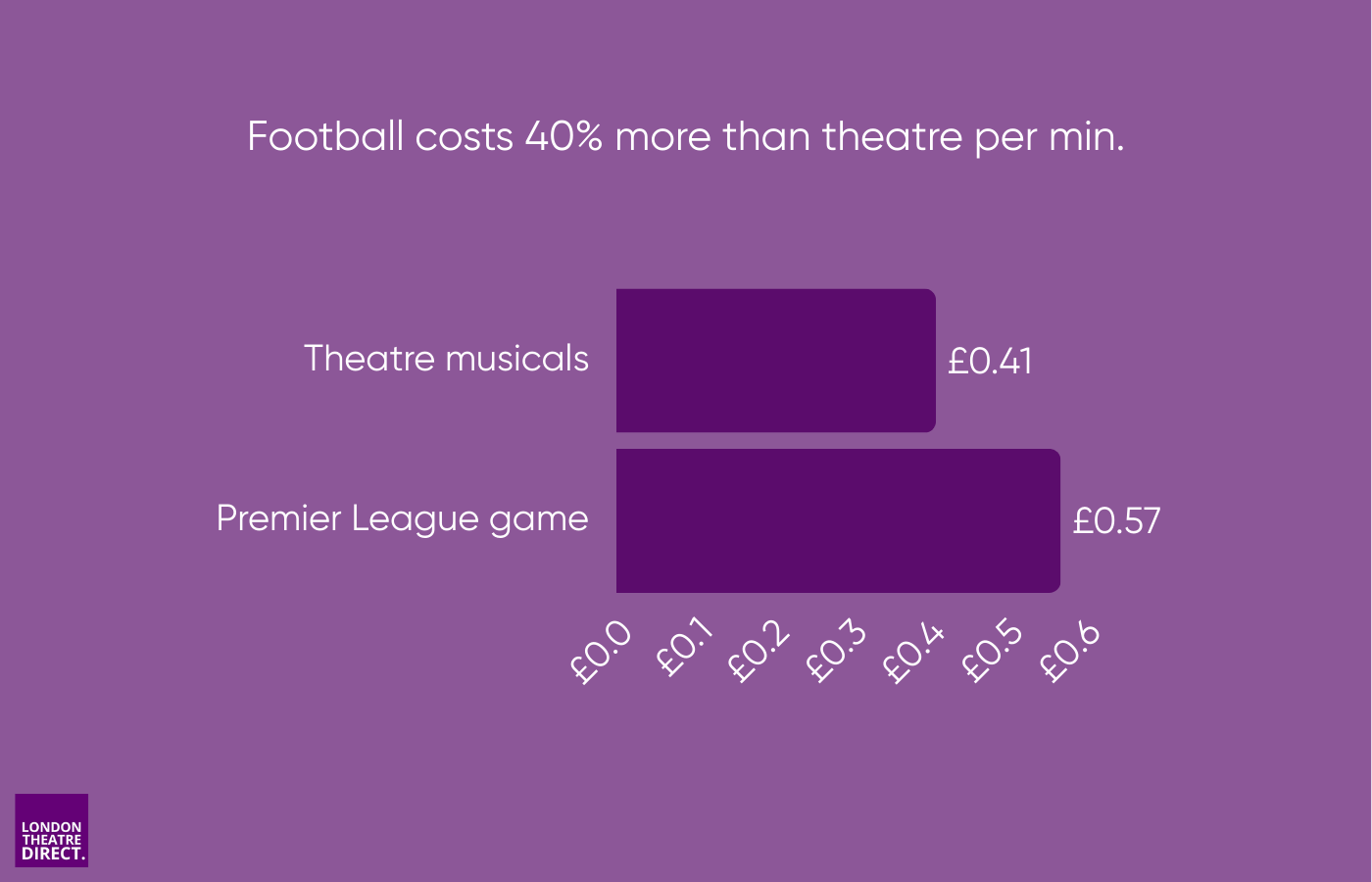
But football is also shorter (105 minutes, including half-time) while musicals in this dataset run for 150 minutes, and once you do the per-minute maths, the headline price picture flips:
- Theatre musicals: 40.5p per minute
- Premier League football: 56.7p per minute
That means Premier League football is 40% more expensive per minute than theatre musicals, despite the slightly cheaper average ticket price. Put simply: you get more minutes for your money at the theatre than the ticket price alone suggests.
Cheaper ticket, pricier minutes - football vs theatre is the clearest example in the dataset.
The counterintuitive one: ballet/dance vs Premier League football
This is the sort of comparison you wouldn’t naturally make - but it’s exactly what a single consistent metric can surface.
In this dataset, ballet/dance costs more upfront than a Premier League ticket (£66.35 vs £59.58). But ballet/dance is also longer (150 minutes vs 105), which flips the value-per-minute outcome:
- Ballet/dance: 44.2p/min
- Premier League football: 56.7p/min
So, despite the higher ticket price, Premier League football is still 28.3% more expensive per minute than ballet/dance in this index.
Live music concerts vs Premier League football: longer doesn’t always mean better value
Live music and Premier League football sit in the same cultural lane: two of the UK’s biggest “big night out” staples according to Statista. Concerts tend to run longer than a football match, but once you put ticket price and duration on the same scale, the per-minute maths still separates them.
- A Premier League match averages £59.58 for 105 minutes (including half-time), working out at 56.7p per minute
- A live music concert averages £105.60 for 148 minutes, which comes to 71.4p per minute.
That means live music costs about 1.26× as much per minute as Premier League football, roughly 26% more expensive. That’s not a judgment on either experience, and not a massive surprise given the ticket inflation that’s rolling through the music industry. It’s just the blunt arithmetic of modern leisure: more minutes only help if the ticket price doesn’t rise even faster.
A second lens: minutes per £1
Another way to feel the spread is to flip the metric and ask: how many minutes do you get for each pound spent?
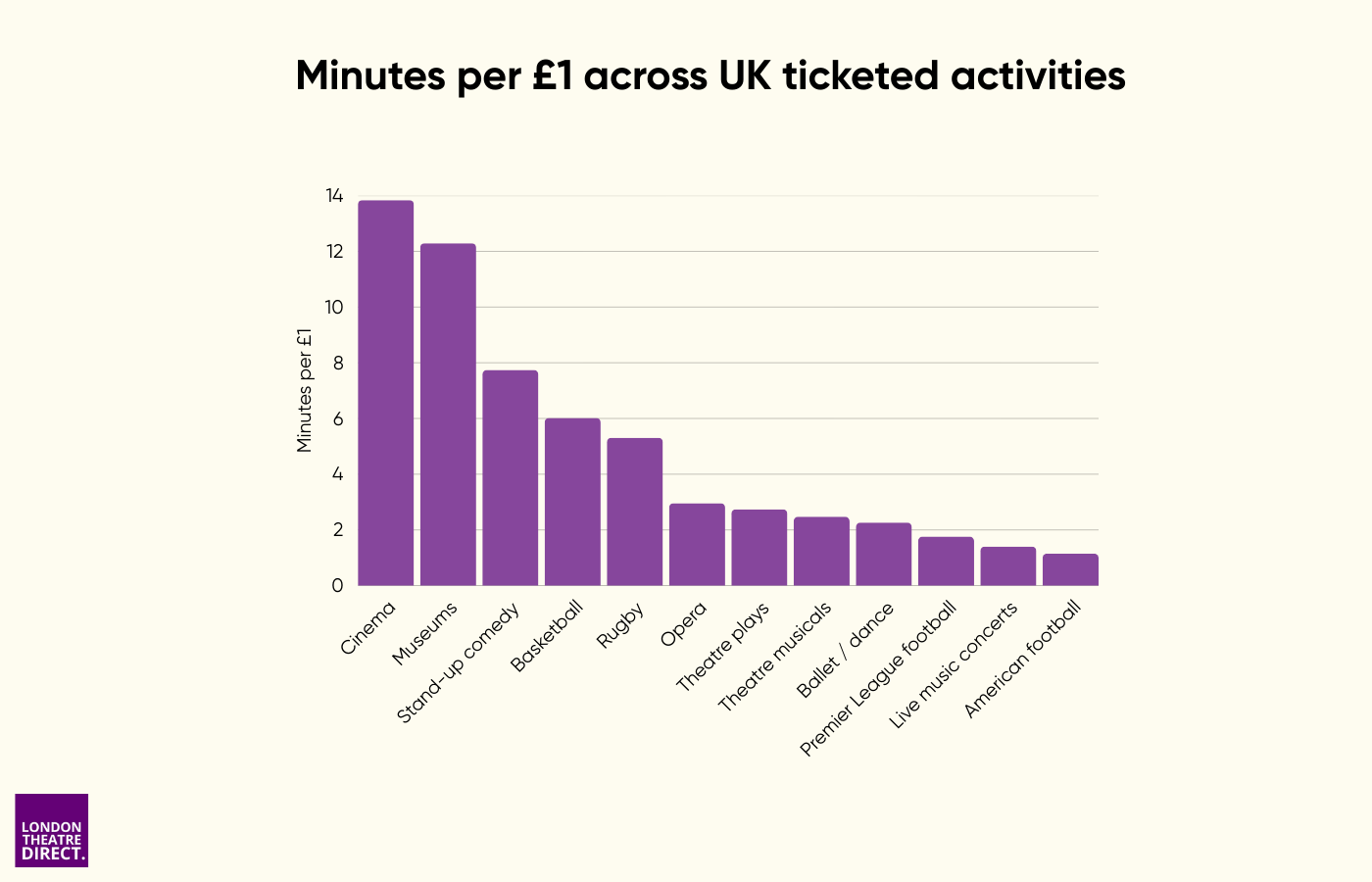
In this dataset:
- Cinema: ~13.8 minutes per £1
- Museums/historic sites: ~12.3 minutes per £1
- Rugby: ~5.3 minutes per £1
- Theatre plays: ~2.7 minutes per £1
- Premier League football: ~1.8 minutes per £1
- American
football: ~1.2 minutes per
£1
That’s not a judgment on quality either. It’s simply the math of leisure - and it’s why theatre often looks stronger on value once you compare what a ticket buys you in time, not just in price.
What this means if you’re planning a night out
This index isn’t here to tell anyone to stop going out on expensive days/nights. That would be bleak, and frankly, unrealistic. It’s here to make the trade-offs clearer.
If you’re after maximum time for minimum spend, the cinema and museums dominate.
But when it comes to premium live experiences, things get more interesting: theatre’s cost-per-minute is broadly in line with other major ticketed nights out, and in some like-for-like comparisons it offers more value-for-money from a time point of view than you might assume from the headline ticket price.
Appendix: Methodology
Activity selection: Activities were drawn from YouGov’s list of popular UK leisure activities and Statista’s most popular sports (Sept 2025). We focused on out-of-home, ticketed activities, including cinema, museums/historic sites, stand-up comedy, theatre (plays, musicals), opera, ballet/dance, and live music concerts.
For sport, we selected those with consistent, comparable durations: football, rugby, basketball, and American football. Sports with highly variable durations (e.g., cricket, tennis, boxing) were excluded.
Price inputs: Theatre: Average ticket prices from London Theatre Direct aggregated National data. Non-theatre: Prices from public sources; where low/high ranges were provided, we used the midpoint.
Duration inputs: Typical durations were based on publicly stated or widely accepted benchmarks: e.g., film length for cinema, visitor guidance for museums, match times for football, average set length for live music.
Calculations: Cost per minute = Average ticket price ÷ Typical duration. Presented in pence per minute (p/min, 1 decimal), with £/min (2 decimals) for values above £1.
What this index does and doesn’t measure: This is a planning heuristic, not a statement of “best entertainment.” It excludes travel, food/drinks, merchandise, concessions, subscriptions, seat quality, seasonality, and resale pricing. Non-theatre comparisons are category-level only; theatre uses aggregated LTD data.
The full data file is available upon request.