
Inside Myra’s Story with Fionna Hewitt-Twamley
Published on 9 April 2026
Summary
- Myra’s Story returns to Trafalgar Theatre with Fionna Hewitt-Twamley.
- The play has raised over £450,000 for homeless charities.
- It challenges audiences to see the person behind homelessness.
In the 19th century George Bernard Shaw’s Widowers’ Houses raised awareness about slum landlords and the appalling conditions in which many people were forced to live. Last century Larry Kramer’s The Normal Heart did much to change attitudes around Aids, and theatre shows such as Athol Fugard’s The Island played a key role in bringing an end to apartheid by raising international awareness.
Only the other week I spoke with the young activist Valentina Andrade about My Uncle Is Not Pablo Escobar, currently at Brixton House, a play which has played a positive part in transforming how London’s fast-growing Latinex community sees itself and how London sees it.
Theatre genuinely can make change, and one show which has been doing that for eight years is Brian Foster’s one-woman play, Myra’s Story, performed by Irish actor Fionna Hewitt-Twamley, which returns to Trafalgar Theatre this week.
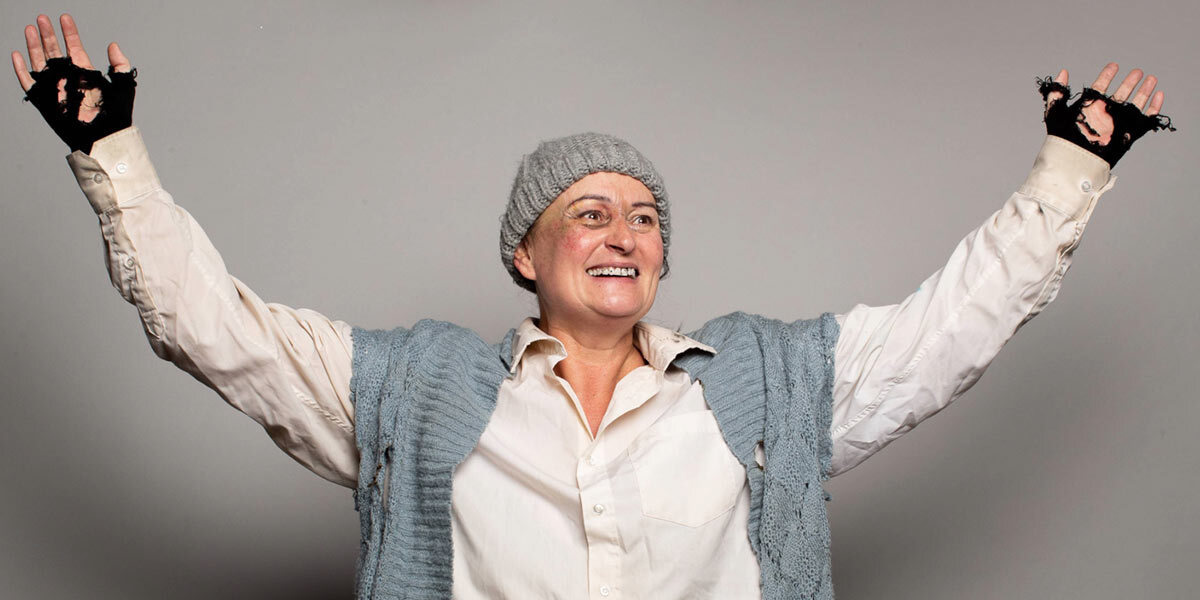
Over the last eight years, the play, which tells the fictional story of Myra McLaughlin, a middle-aged homeless alcoholic Dubliner, has raised over £450,000 for homeless charities. Hewitt-Twamley says that she has no intention of stopping until the play has raised at least a million. I believe her. Her dedication to the play is such that it comes with more than a whiff of authenticity: Hewitt-Twamley hasn’t washed the clothes she wears on stage once during the last eight years.
But important though the fundraising has been, Hewitt-Twamley says that she thinks the real importance of Myra’s Story is in its ability to change perceptions.
“I am showing people the person behind the dirty woolly hat and showing that there was a life lived before and there is a possibility of a life beyond where a homeless person finds themselves at that moment. So often those who haven’t experienced homelessness think that the homeless have made a choice to be on the streets. But one of the things the play does is remind us that Myra is an ordinary person, and what happened to her can happen to almost anyone. Most of us are just a couple of paycheques away from the streets, and a lost job, a divorce, a death, or terrible grief can be all it takes to change the course of your life.”
As soon as she read the play, Hewitt-Twamley knew that she wanted to do it, not just because it’s an actor’s dream – she gets to play 16 characters in a tour de force performance-- but also because she could see the power of the play to change hearts and minds about homelessness and those who are experiencing it.
“It entertains; there’s plenty of comedy,” she says, “but it’s powerful too because one of the things we so often do when we see a homeless person is that we make judgements on the basis of what you see in front of you, and what Myra’s Story does is really tell her story, the ups and the downs, so that people see beyond the hat.”
After the curtain has fallen at each performance Hewitt-Twamley talks with the audience about perceptions. Over the years the play’s Facebook page has received thousands of messages with people eager to share how the evening has moved and changed them.
“They carry it with them out of the theatre and into their lives and into their interactions with homeless people. Often the instinct is to turn your eyes away, but the play makes people look at the homeless and really see them because it tells the story behind that homelessness.” Hewitt-Twamley argues that if you don’t know someone’s story, then you are not in any position to judge them.
Judgement remains widespread, with some arguing that dropping a coin in a cup is wrong because it’s a coin which will be spent on drugs or alcohol. Hewitt-Twamley thinks maybe more understanding is needed about the nature of addiction and the hardness of life on the streets.
“There is a bit in the play when Myra tells a story about not being able to get into a hostel on a particular night. She is given some money, and she spends it on alcohol, and she says that she doesn’t have the wherewithal of a shelter to keep her warm and protected, so she will drink because she needs to obliterate memory and forget who she is for a short time because it will be the only peace she gets. So, I say, who are we to judge?”
She adds, “If I see someone on the street, I am trying to behave in a way that says, ‘I see you. You have a name. You matter to me enough for me to get down to eye level and talk, which isn’t about dropping money in a cup and thinking my duty is done. I won’t stand above them pontificating about what they should do or changes they should make. That’s not my call. This is their life, not mine, and it’s a very fragile life.”
Over the eight years she has been doing the play, she reckons that homelessness has become a bigger problem, and the demographic has shifted too. “Gambling addiction has become a big reason why people are homeless and there are more women and young people.”
It is not a problem that is going to go away, but Myra’s Story ensures that we can’t ignore it because in making us bear witness to Myra’s life, it gives every homeless person visibility and makes it harder for us to avert our eyes.
Myra's Story plays at the Trafalgar Theatre on 12 and 19 April. Book your tickets today.
By Lyn Gardner
Lyn Gardner is an acclaimed theatre journalist and former critic with decades of experience covering British theatre, from off-West End and fringe theatre to major West End productions.