The Holy Rosenbergs review: A gripping, urgent and deeply humane family drama
Published on 10 March 2026
A lot has happened since Ryan Craig's The Holy Rosenbergs first opened 15 years ago. London hosted the Olympics, the US re-elected its first African-American President, and we got an extra bank holiday when Charles III was crowned king. Yet alongside these moments of optimism, we’ve also navigated political upheavals, renewed tribal debates about identity and belonging, and an alarming rise in antisemitic attacks. Conversations around Israel and Palestine have grown louder and more polarised, with accusations tarring entire communities with the same brush. The return of The Holy Rosenbergs therefore, feels less like a revival and more like a reminder - there are real people at the heart of these world events, and they are all at risk from prejudice and persecution, as Saul (Dan Fredenburgh), the synagogue leader and the Rosenberg’s family friend, states “When Israel is attacked we all feel the sting”
It’s timely that the production arrives just as the Olivier-nominated revival of All My Sons finishes its West End run. Both plays use domestic drama to confront, and humanise, international conflict. Its patriarchs, David Rosenberg and Joe Keller, may be separated by decades and continents, yet they share the same uneasy burden: fathers living in the shadow of a son lost to war, and the moral guilt that comes with their, supposed, involvement in it. With All My Sons closing, The Holy Rosenbergs takes up the mantle. It shines a light on the families behind the headlines, the pressure that global scrutiny puts upon them, broken by a political divide, the everyday casualties of war.
The play opens to the sound of Dizzee Rascal insisting that there’s nothing crazy about him, Jonny (Nitai Levi), David (Nicholas Woodeson) and Lesley’s (Tracy-Ann Oberman) youngest son is lounging on the sofa next to the midi hifi system, mouthing along to the lyrics and scribbling in a copy of the Racing Post. We’re transported to 2009, and the immediate aftermath of the Gaza war. However, with its extendable dining room table, garish patterned carpet and oak paneled units (designed by Tim Shortall), the house feels older still. It’s a place where history lingers. David and Lesley, the heads of the family, speak as though they’ve been navigating suspicion and accusation for generations, their familys story, and the legacy of the Rosenberg name, stretching back far beyond the events of the play itself.
And the play itself, centres on the aftermath of Danny Rosenberg's death, and his sisters, Ruth (Dorothea Myer-Bennett), investigation into it. But her reports into her siblings death aren’t powered by revenge or retribution, much to the fury and upset of her family and community, she is working with the UN, and Sir Stephen Crossley (Adrian Lukis), on a report into war crimes in Gaza.
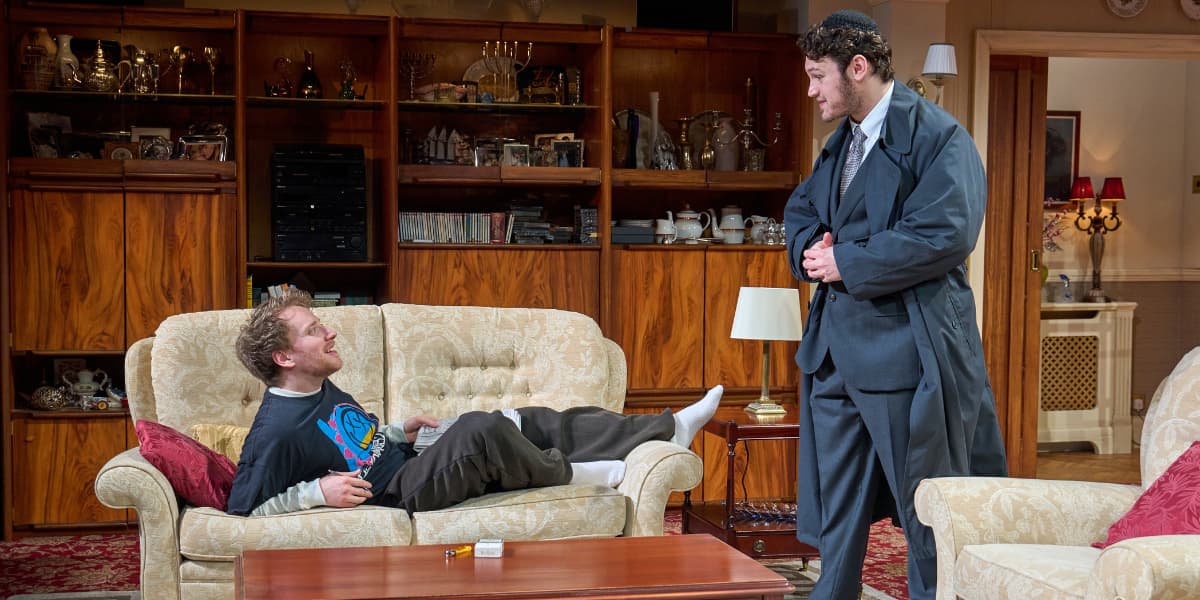
Despite the weight of the subject, Craig keeps the drama grounded, interweaving it into the rhythms of the familiar family life. Mum, Lesley, like most mothers around the world, insists that every houseguest - expected or not - must be offered, and then given, tea, whether or not the invitation to the cuppa was accepted or not. She also forces food onto everyone that steps through her door, encouraging them to take home half the fridge when they leave the premises, stomachs already full and buttons close to bursting.
Craig’s script is full of moments like this, humour bubbling up where you least expect it. When Ruth confides to the Rabbi (Alex Zur) that she needs to attend her brother’s memorial - despite pro-Israel protestors threatening to show up at the service if she does - because she’s grieving and needs to be there, he replies with well-meaning clumsiness: “You can grieve anywhere, though.” It’s shocking, awkward, and funny all at once.
Big questions and bigger emotions creep into everyday conversations. Arguments about international law or national loyalty arrive between mouthfuls of marble cake and complaints about borrowed cars. It’s often funny, always sharp and deeply humane, a play that understands the most explosive debates rarely happen on television panels but around dining tables.
At the centre of it all stands David Rosenberg. Nicholas Woodeson gives a wonderfully layered performance, veering between bluster, fury and something much more fragile. When the family name is slighted he practically vibrates with indignation, yet the bravado never quite hides the cracks beneath. As the evening progresses he seems to shrink before our eyes, gazing into the distance as though trying to detach himself from the chaos around him. At one point he casually floats the idea of ending it all, a line delivered so matter of factly that you can’t tell whether it’s gallows humour or a moment of raw honesty.
Dorothea Myer-Bennett brings intelligence and emotional precision to Ruth, balancing sharp conviction with flashes of vulnerability as the pressure around her mounts. And Tracy-Ann Oberman grounds the household as Lesley, a grieving mother who keeps herself moving through baking, and flower arrangements. Her brisk hospitality provides some of the evening’s warmest laughs, even as the sadness beneath it remains unmistakable.
Funny, poignant and necessary. The Holy Rosenbergs is a fiercely intelligent family drama that proves the most complicated global conflicts are often felt most acutely at home.
The Holy Rosenbergs plays at the Menier Chocolate Factory until 2 May 2026.