
Grace Pervades review: Ralph Fiennes and Miranda Raison shine in David Hare's tribute to Victorian stars
Published on 1 May 2026
- Ralph Fiennes and Miranda Raison star in David Hare's tribute to Henry Irving and Ellen Terry.
- Witty, intelligent and moving; Grace Pervades is a richly entertaining evening that reminds us why great theatre endures.
The Theatre Royal Haymarket has transformed into the Lyceum, but you won’t see any singing Serengeti animals here. Long before The Lion King ruled the West End venue, it belonged to another king entirely: the titan of Victorian theatre, actor-manager Henry Irving (Ralph Fiennes).
Grace Pervades charts Irving’s management of the Lyceum from 1878 to 1902 and documents - through 25 scenes and 24 years - two artists, Irving and his leading lady, Ellen Terry (Miranda Raison), who are bound together by work, admiration and broken promises.
Terry acts with joy, charm and warmth, a choice that was ridiculed by some critics at the time. She was seen as ‘too sexual to be an actress’, and it’s where the title of David Hare’s 32nd play found its name, an abbreviation of a review “Grace pervades the hussy.” She is the polar opposite of Irving, who plays everything with sorrow and tragedy “an evening with me can be very grim” he admits.
It is a professional, and personal, relationship that shouldn’t work but did.. Terry’s easy confidence allows her to challenge Irving in ways few others can. She is one of the only people able to puncture his self-seriousness, gently offering notes on his performance style “your acting could be improved if, from time to time, you looked at the other actors.” She gets some of the biggest laughs of the evening (and there are a lot of them).
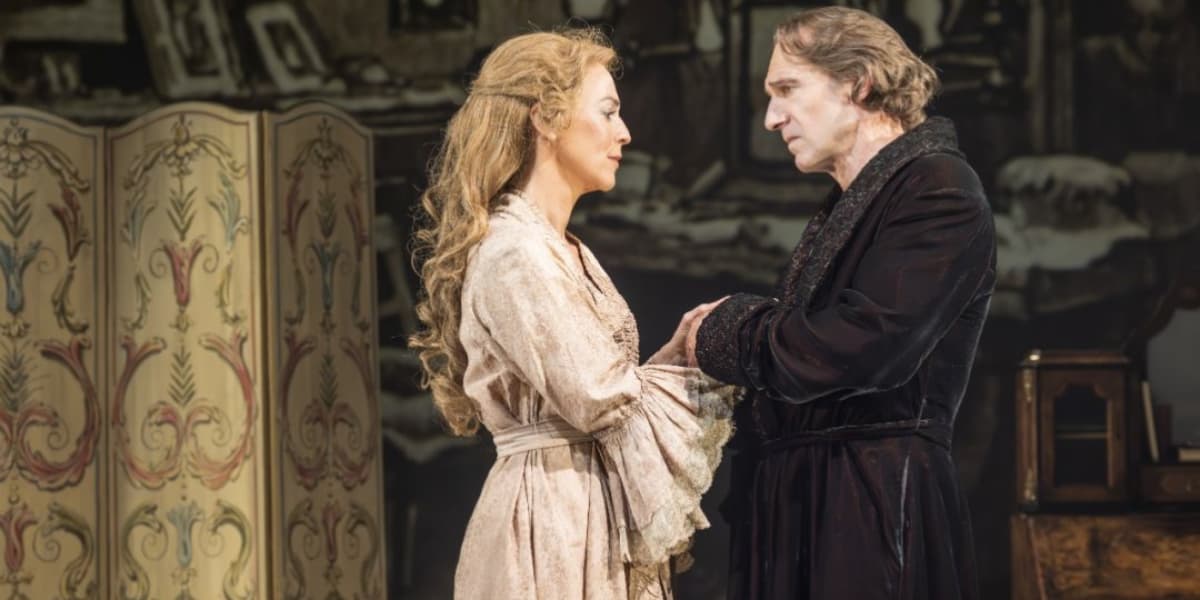
It’s a theatre production about theatre, and it fully embraces the “theatrics” of it all. After all “why is ‘theatrical’ seen as a negative in the arts? You don’t hear of music being too musical” Terry complains. Designed with fun and flair by Bob Crowley, the set mimics the sets of Irving's plays from the 1800s; backdrops are displayed in the middle of a proscenium arch and scene changes are covered by lush red curtains, while its characters address the crowd, mimicking Shakespeare’s ‘aside. A nod to Irving's connection to the Bard (his landmark 1874 Hamlet, which ran for more than 200 performances, an unheard of milestone for a Shakespeare production at the time),
There are easter eggs throughout the show for those who are fans of the form, and if you’re here the chances are that you are. Early on we see Irving’s company in rehearsals for Hamlet, where Irving patronises Terry, telling her that she can’t wear a black corset as Ophellia “because you see, I always thought of Hamlet as being the main character” and goes on to explain that, as the lead, he needs to wear black to stand out. Irving remains dressed in black for most of the play, we’re in no doubt then, that he is the lead in his life, and the star of every room he occupies, much to the annoyance of others.
Although Grace Pervades pays tribute to theatrical tradition, it is far from a love letter to the art form. Irving, along with Terry’s son Teddy, frequently questions theatre’s purpose, dismissing it as vain, pointless and self-important. Thankfully, this production isn’t any of those things!
Despite the characters’ insistence that the best plays are often the ones that never open, this is definitely worth seeing. Its dry, matter-of-fact humour is scathing and hugely satisfying. Fiennes is clearly having fun with Irving’s theatrical excesses and melodrama (and as the star of The Menu, he certainly knows how to make a meal out of something…). The result is often very funny, and surprisingly modern for a play centred on a man so fixed on preserving tradition. “Give them the unexpected, not the unacceptable,” Irving laments, clinging to his own rules as the world shifts around him
The central performances are excellent. Fiennes is hugely entertaining, capturing both Irving’s grandeur and absurdity, while Raison gives Terry a grace and vulnerability that anchors the play. Together, they make this portrait of creative partnership compelling from start to finish.
The supporting cast adds further texture, particularly Jordan Metcalfe as Terry’s frustrated son Edward and Ruby Ashbourne Serkis as Terry’s daughter Edith, whose impatience with theatrical convention gives the play much of its forward-looking energy.
It is witty, intelligent and moving; a richly entertaining evening that reminds us why great theatre endures. For all its arguments about theatre’s limitations, it ultimately makes a convincing case for why these stories, and the people who tell them, still matter.
Grace Pervades plays at the Theatre Royal Haymarket until 11 July 2026.