
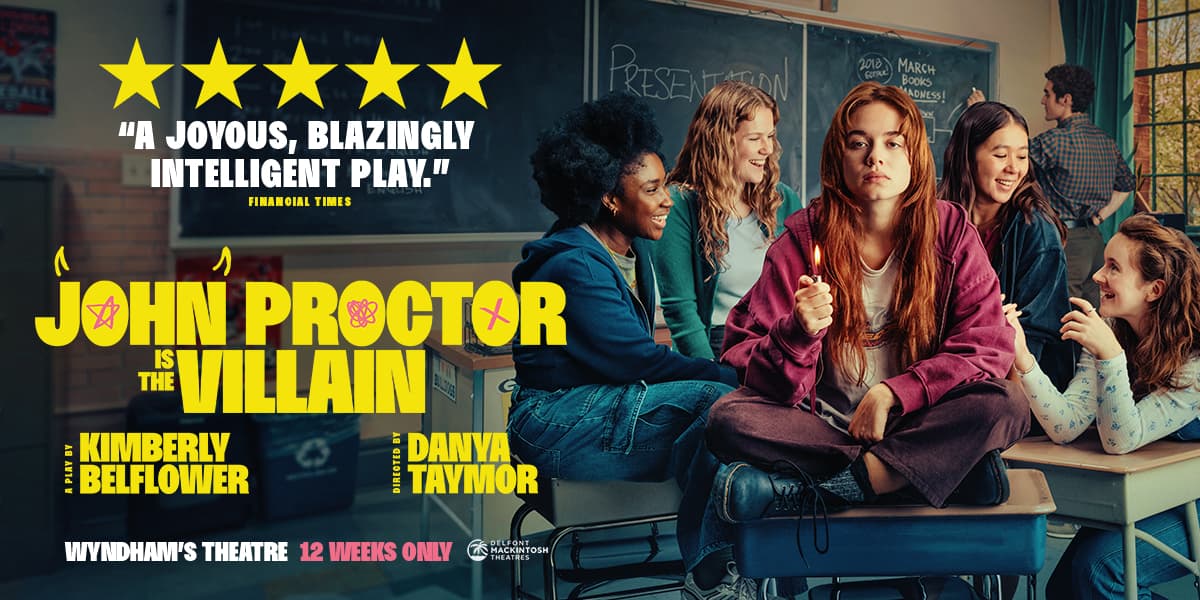
10 Reasons to See John Proctor is the Villain at Wyndham’s Theatre in February
Published on 24 November 2026
Kimberly Belflower’s play is such a breath of fresh air, both fiercely intelligent and giddily euphoric. Your teenage daughters and sons will thank you as much as you will thank yourself for organising tickets. You will be able to tell them the plot of Arthur Miller’s The Crucible, a play inspired by the 17th-century witch trials written as an allegory for the McCarthy witch hunts that took place in 1950s America. They’ll be able to explain all the contemporary cultural references you might otherwise miss. It’s genuinely a theatre show for theatre lovers but also for anyone who doesn’t think theatre is for them.
John Proctor is the Villain sets its own dramatic plates spinning by setting the action in 2018 in small-town Georgia, just as the #MeToo movement is flowering, a place where Salem religiosity and gossip meet. Mr Smith, the charismatic high school teacher, introduces his class of 16-year-olds to Arthur Miller’s play. He says that one of the central characters, John Proctor, is “one of the best characters ever”, essentially a good man and the play’s hero. But will his teenage students agree? Don’t bet on it.
The stakes rise with the return to the classroom of Shelby, who left the school amidst rumours of sexual misconduct. Her return lights a bomb under the play, and it explodes across the stage. The relationships in this play are layered and complex, whether it is that between Raelyn and her controlling boyfriend or how Ivy ties herself in knots defending her father, who is under a cloud for sexual harassment.
If you have enjoyed Ava Pickett’s 1536 or Morgan Lloyd Malcolm’s Emilia, this will be right up your street. Remember that unforgettable “burn this house down” moment in the latter? John Proctor is the Villain has moments that evoke a similar feeling.

It is clever the way that the play is in dialogue with past and present and is a contemporary play written with a female lens bouncing off of the older play, written by a man. It is not a take-down of The Crucible but rather uses it as a reflection of how context changes meaning and how we perceive the way narrative is constructed and the stories we tell. It is a play that constantly asks what art is for and how does art change or is received in the light of social and political change.
If that sounds heavy, it is done with a lot of hormonal intensity and joy and the lightest of touches with references to Harry Styles and Twilight and cleverly placed dollops of Taylor Swift and Lorde. Particularly the latter’s Green Light with its lyrics “but I hear sounds in my mind/brand new sounds in my mind.” #MeToo is the sound that is giving these young women a new way to evaluate their lives, their own culture and the culture which has been handed down to them.
But because it is set in 2018, it also offers up a sharp reminder that the distance between 17th-century Salem, 1950s USA, a classroom in Georgia in 2018 and our own era is perhaps less than we think. As the lack of accountability of Jeffrey Epstein’s associates demonstrates, women are often disbelieved when they accuse powerful men of abuse. This is a play which constantly pushes us to question what we think we know.
It is directed by Danya Taymor, niece of Julie Taymor, who directed The Lion King.
On Broadway, where the play was seen in 2025, it starred Sadie Sink, recently such a brilliant Juliet in Robert Icke’s Romeo and Juliet. The London cast for this transfer from the Royal Court are more low-key, but they are just fabulous. This is likely to do for many in this cast what the History Boys did for its cast 20 years ago. By the way, The History Boys is being revived next year at the Theatre Royal Haymarket, and it will be fascinating how that reads today when attitudes towards safeguarding are very different from when it was written and the time it portrays.
In Miller’s The Crucible, it is the discovery of a group of teenage girls engaging in the forbidden activity of dancing in the woods which sets the drama in motion; in Belflower’s play dancing becomes an act of defiance, a kind of exorcism, offering both the girls and the audience a moment of catharsis. That moment is worth the price of admission alone.
Playing at the Wyndham's Theatre from 2 February to 24 April, book your John Proctor is the Villain tickets today.

By Lyn Gardner
Lyn Gardner is an acclaimed theatre journalist and former critic with decades of experience covering British theatre, from off-West End and fringe theatre to major West End productions.