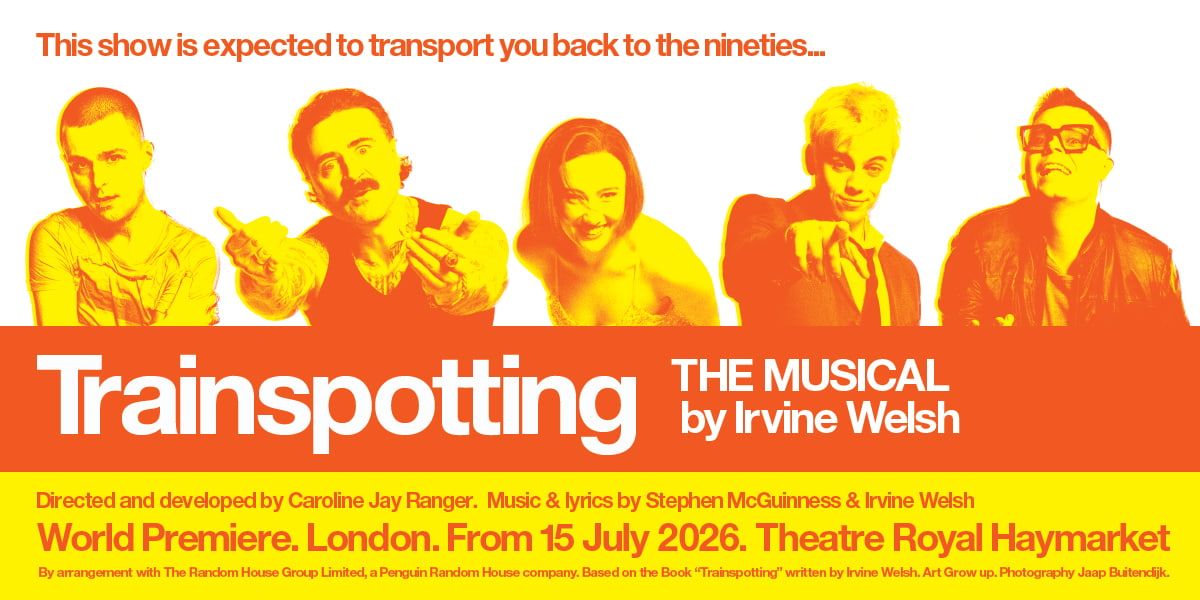
Finding Its Own Rhythm: Trainspotting the Musical Review
Published on 23 July 2026
Last updated on 7 August 2026
Summary
- An affecting new take: Trainspotting the Musical, championed by Irvine Welsh, offers a satisfying and enigmatic recreation of the cult-classic
- Brilliant performances: Boasting a capable cast including Lewis Kidd as Renton, Sheridan Townsley as Sick Boy, and Frankie O’Connor as Begbie, who sparkle in the familiar roles etched into the British cultural cannon of the 90s
- Choose a ticket: Embrace the distinctly fresh return which gives Welsh’s worlds new space to breathe on the Theatre Royal Haymarket stage
**CHOOSE PHONES OFF. CHOOSE BEING IN THE MOMENT. CHOOSE LIFE. **The Tannoy at the Theatre Royal Haymarket commands in familiar Leith drawl, instantly conjuring the unmistakable spirit and affection of **Irvine Welsh's **culturally enduring 1993 novel, Trainspotting. This time revived in its most unexpected form yet, polarising on a good day, a musical. Nostalgia and adoration both palpable, the audience descends into whooping and applause as the lights dim and a neon t-shirt-clad (slightly more jacked than junkie) Renton takes the stage.
A New Pulse for Trainspotting
Emerging on stage as our protagonist and intermittent narrator, Mark Renton (played by Lewis Kidd), is our guide through the flawed characters and splintered relationships at the heart of Welsh’s story; against the backdrop of the schemes and social clubs of 1980s Leith, Edinburgh. Following his undeniably extreme, yet resonant circle of friends, as they navigate the disillusionment of Thatcher’s Britain; a world of no jobs, no prospects, no hope and the ultimate consensus, no point. No point, that is, until heroin offers the fleeting promise of escape.
Among them are Sick Boy, the charismatic, self-serving manipulator (mainly of women), the jittery, kinder-hearted, yet ultimately failing Spud, boyish and romantic, but naively doomed Tommy; and Francis Begbie, the roughest diamond of them all, a violently loose-cannon who, while wielding a pint glass and switchblade any chance he gets, remains unflappable in his moral anti-heroin stance throughout. Their female counterparts, Kelly, Lizzy, and Alison, while more initially hopeful and ambitious are burdened differently by relationships, pregnancy, and grief, and equally, if not more so, bear the fallout of the hopeless era and its zombifying medicine on offer. Trainspotting the Musical remains a story about addiction, friendship, betrayal, and the search for purpose in a world that promises little to anyone who bothers.
It’s a tall order in the shadow of a generation-defining novel and an acclaimed film that embodied the angsty zeitgeist of 1990s Britain. And it’s not the raw gritty realness evoked in Welsh’s original words, or the kinetic, restless chaos of Danny Boyle’s 1996 direction, it’s something new. Written by Welsh and brought to life by Caroline Jay Ranger’s direction, Stephen McGuinnes’ music, and Colin Richmond’s set, the West End production offers a fresh humorous and heartwarming, yet equally spirited adaptation.
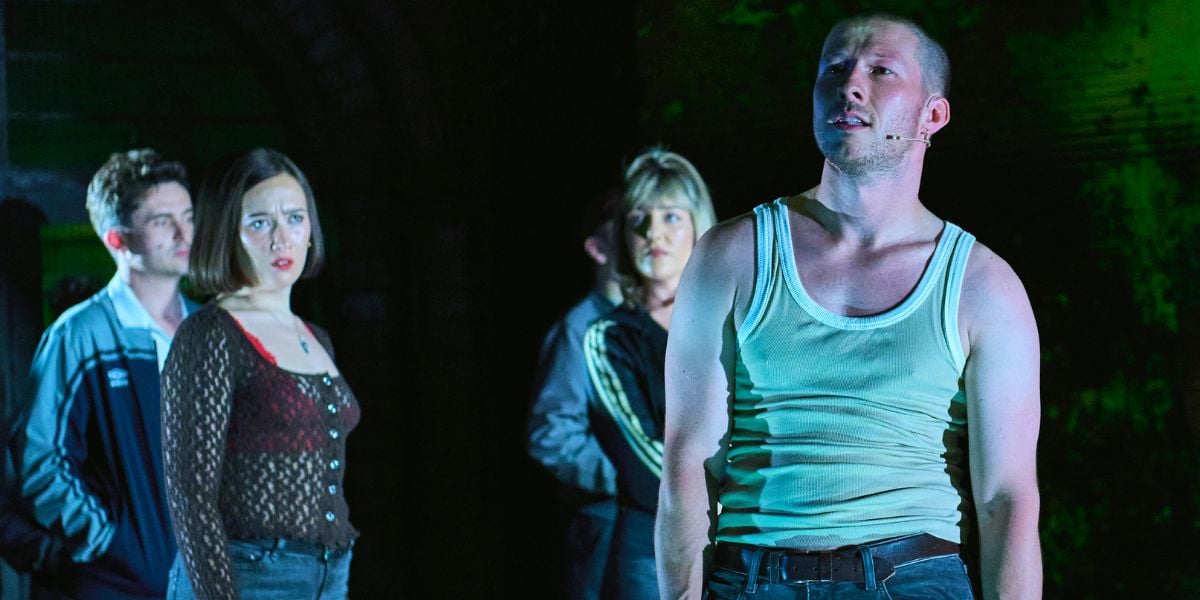
Fresh cast, the same menacing swagger
Lewis Kidd as Renton lacks the scrawny physique one might expect from Welsh’s lead, though this is quickly forgiven by his physical performance, for me, culminating in a visceral cold-turkey scene which sees Kidd agonisingly convulsing in jittery spasms so convincing that I hoped his dressing room really is stocked with Heinz tomato soup. Frankie O’Connor’s rendition of Francis Begbie had me thinking he might have watched the movie, cigarette poised between lips, every night leading up to the performance, as he injects an uncannily familiar swagger, reminiscent of Robert Carlyle’s iconic screen performance. Sheridan Townsley effortlessly exudes the arrogant bravado of Sick Boy, while Kieran Andrew has mastered the jittery gurning existence of Spud, providing much needed comic relief and emotional vulnerability.
Breathing new life to the women of Trainspotting
Rosie Dignan as the doomed Alison gives an impacting performance, both restrained and unleashed, as her character faces a tragic spiral. Refreshingly, the musical affords its female characters with more space as a starker comparison between the experiences of Kelly, Lizzy and Alison and those of the men is drawn. While levelled by class and environment it becomes poignantly clear that the women bear a greater brunt of societal responsibility, and as Sick Boy boasts freedom and a 'lust for life', it’s an uncomfortable watch as he avoids parenthood in a way Alison cannot. Memorable performances across the cast deliver the same heart and emotional weight that has immortalised the characters in the British cultural cannon since the novel emerged in 1993.
No frills, no escape
Colin Richmond’s stripped back set effectively serves the characters, allowing for seamless transitions from social clubs to skaggy bedrooms and reinforces the claustrophobic nature of the groups entangled relationships and lack of escape from each other. While the smoke-shrouded silhouettes appearing frequently atop the cleverly positioned balcony, add effectively to this physical feeling of entrapment.
Memorable classics from the film and newly co-written pieces from Welsh and Stephen McGuinnes make up the unlikely score. The strongest numbers, drawing on gothic rock, northern soul, and country, propel the narrative forward, acting as hazy but bright extensions of the characters' drug-fuelled internal monologues. A particular stand-out is Dingan’s solo Oblivion, which perfectly scores Alison’s bleary descent into narcotic numbness and in the end, a scheming bookie’s flat. While a handful of more conventional ballads feel less at home in the world of Trainspotting, the music largely succeeds as a storytelling device and enhances the exciting technicolour of the highs and crashingly bleak grey of the lows.
A story that refuses to date
On my journey home the songs (old and new) echo, mixed amongst the rumbling racket of the Piccadilly line, a nice reminder that this adaptation succeeds not by recreating what came before, but by finding its own, distinct rhythm. The stage gives Welsh’s world new space to breathe, specifically for its female roles, while the cast satisfyingly captures the humour, heart, and humanity that has allowed these characters to endure for decades, energising a story that seems yet to date. Safe to say, I've never felt quite so healthy enjoying my nightly walk-home cigarette.
Trainspotting the Musical plays at the Theatre Royal Haymarket until 5 September 2026.