
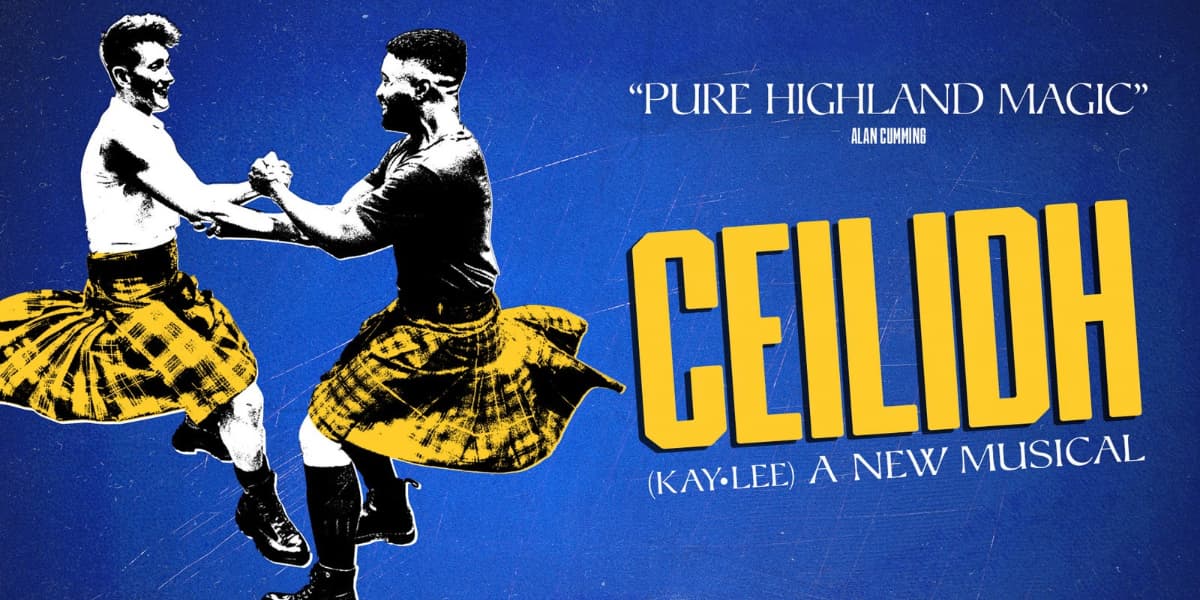
Sam Pinkleton on the Joy of Bringing People Together with Ceilidh
Published on 14 October 2026
Summary
- Lyn Gardner interviews Ceilidh director Sam Pinkleton and creators Scott Gilmour and Claire McKenzie.
- “There is no forced fun” – discover the musical inviting audiences to join in, their own way.
- Ceilidh comes to Shoreditch Town Hall from 21 October to 13 November.
“I bristle at the words participatory or immersive in theatre,” says Sam Pinkleton, director of the hit show, Oh, Mary!, “because to me they signal I’m going to be scared and have a bad time.”
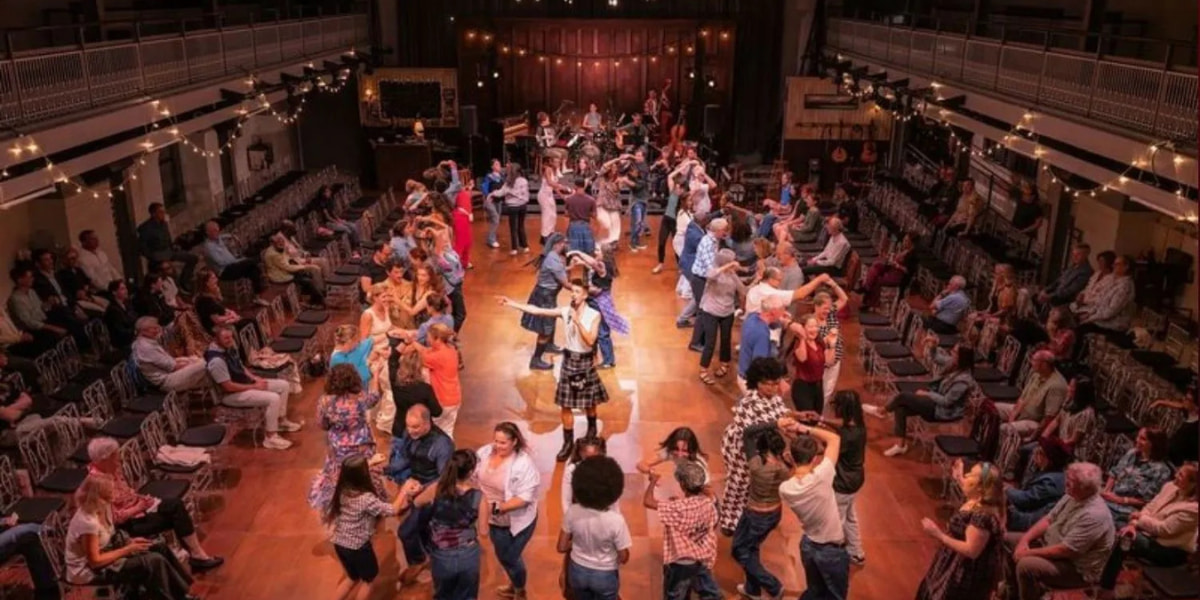
So, what on earth is Pinkleton doing directing Ceilidh, a new musical written by Scott Gilmour and Claire McKenzie, aka Noisemaker, which opens at Shoreditch Town Hall later this month? Because Ceilidh is definitely participatory, inviting the audience to join in a show which takes the traditional Scottish gathering involving dances such as Strip the Willow and the Gay Gordons and gives it a narrative and theatrical spin?
Despite his initial misgivings, the thing which piqued Pinkleton’s interest was a trip to Glasgow with Gilmour and McKenzie, who had been developing the show, to experience some traditional Scottish ceilidhs.
“As the dumb American on the team, I had no reference point for a ceilidh. But I loved that the form is so democratic and intergenerational, and there were all these different bodies engaging in their own way. It is impossible to look cool doing a ceilidh dance. It’s a great equaliser.”
He saw the genuine possibilities for the musical. "I often say that our show is an elaborate two-hour trick to get strangers to make eye contact. This is a piece of theatre which simply asks people to be together in a space. It is always welcoming you in, not intimidating you.”
“There is no forced fun,” says Gilmour firmly. He started working with McKenzie on the idea of using a ceilidh as a framework for a new musical back in 2018 with a 10-minute tryout out at Sloans’ ballroom in Glasgow. “If you want to get up and dance, you are very welcome, and if you want to sit and watch or go to the bar for a drink, you can. There is no version of the show which depends on everyone getting up and dancing.”
McKenzie points out that nobody should worry about not knowing the dances. Just as happens at a traditional ceilidh, the dances are called by the caller—a crucial role--so everyone can join in.
"We teach you the dance, so whether you have never heard of a ceilidh or you have been to a 100, we meet you where you are.” She adds that normally when creating a musical, it is very tightly developed so “that you are delivering the same pace and beat every night. But with Ceilidh, a lot of the development has been about making sure there is time and space for it to allow for what happens in the space, such as someone knocking over their pint or being slower to learn a dance. We work with that, and it’s been a learning experience for us as writers of musicals.”
After that 2018 iteration, the idea sat with the pair for a while, but it was always an itch at the back of their minds while working on other projects. So when they were brought into a commissioning programme run by Beth Williams and Barbara Whitman, they jumped at the chance to explore whether the idea could work as a theatrical experience by entwining their original score with the traditional folk music and a story.
The evidence so far from further showings of early material in Scotland and a run in Baltimore in the US-- where most people had never heard of a ceilidh, let alone know how to pronounce it (say 'kaylee') but were nonetheless queuing up to join in the dance --- is that Ceilidh the show is a winner, a blissful one at that. It arrives in London following a sell-out tour at Alan Cummings’ Pitlochry theatre and will tour nationwide after its London run.
The show definitely isn’t just a shindig. Pinkleton says, “People often ask me, is it a ceilidh or is it a musical? To which my answer is yes. It is both and doesn’t value one degree of participation over the other.”
There is a proper score as well as the traditional tunes and a narrative involving the Caller who has inherited the role from previous generations of their family.
“We discover how that role in the local community has sculpted the family over the generations,” says Gilmour, who also points out that the traditional dance tunes are passed down by ear from one generation to the next. He adds, "They are active and alive, and they change as they are passed down.”
He posits the idea that at a time when we live with an epidemic of loneliness and isolation, there is something about the idea of passing something on – whether it is music or the tradition of calling – which can be comforting, reminding us that “we are all just the next bit in a very long on-going story.”
At first sight it would seem that there is no connection between Pinkleton’s work on Oh, Mary! “a whacky, ahistorical, ridiculous comedy” and Ceilidh “an incredibly sincere Scottish musical". But he argues that “there is an experience of Oh, Mary! on its best nights when the audience is transformed by the simple act of laughing together as a group. It's about the gift of being in the room together, that glorious act of community.”
Ceilidh does that too and maybe more, and directing it has been a revelation for Pinkleton too.
“For the most part, theatre is an elaborately constructed web of lies, but I’ve realised that you can’t lie in this format because you are asking people to trust you to take them on a journey together. So it resists being theatrical with a capital T; as a director you can’t throw a lot of stuff at it. That’s interesting because there is a richness to its simplicity, and not lying but trusting that people will go with you, it creates a trust that people will look after each other. It’s what makes it so joyous.”
Ceilidh The Musical plays at Shoreditch Town Hall from 21 October to 13 November 2026. Book your tickets today.
By Lyn Gardner
Lyn Gardner is an acclaimed theatre journalist and former critic with decades of experience covering British theatre, from off-West End and fringe theatre to major West End productions.